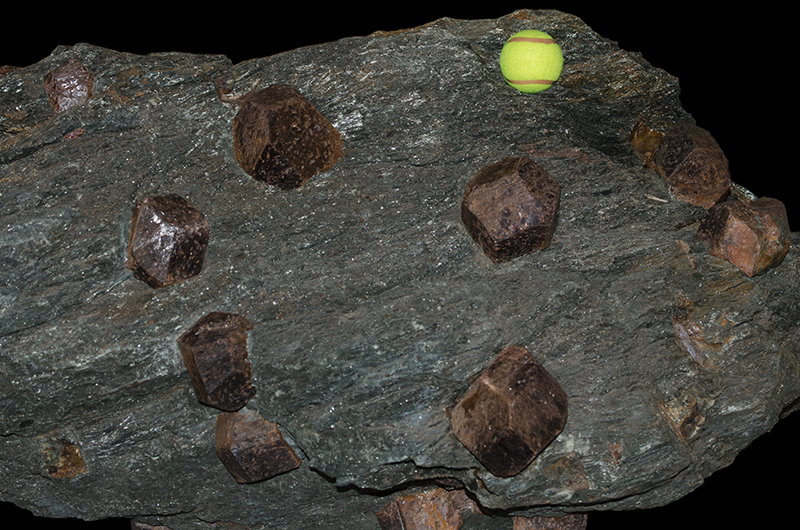
The discovery occurred at the Royal Ontario Museum, where researchers analyzing the NWA 8171 meteorite noted anomalous chemical signatures. Using electron microscopy and laser analysis, the team confirmed the presence of garnet—a mineral typically associated on Earth with tectonic shifts and high-pressure crustal transformations. Professor James Darling of the University of Portsmouth suggests the find provides a new framework for interpreting Martian geology, effectively serving as a billion-year-old time capsule.
Despite the breakthrough, the specific conditions that created the gem remain under debate. Lead researcher Tanya Kizovski of Brock University points to two primary possibilities: intense localized heat from magma rising through the crust or the kinetic energy of a massive meteorite impact. There remains a slim, intriguing possibility that the rock was deposited on Mars by an earlier, separate cosmic collision before eventually being ejected toward Earth. Future oxygen isotope testing, detailed in Geochemical Perspectives Letters, will aim to pinpoint the exact origin of this unexpected celestial traveler.




Comments (0)
No comments yet. Be the first!